Pages

Showing posts with label literacy. Show all posts

Monday, December 17, 2012

"Random" Thoughts

I hear the word "random" used all the time, and so often incorrectly. It seems like it is some of my high school students favorite words, and expressions. I bet I hear at least once a day, "That's so random!!"
 Here's a few thoughts on the word, and some alternatives that perhaps you ought to consider instead.

Random: If something happens randomly, it means that one option out of many different equally possible options occurred. This was not something someone chose. This event could have occurred a different way if things had happened just a little differently. Imagine a dice rolling and coming up a four. It could just as easily come up a 5. This is what random means. Side note: Random things will sometimes repeat. A dice will sometimes come up with the same side showing twice in a row. In fact we can predict how often that will occur (about 17%).  Your iPod does not play songs randomly -- because if it did you would complain that it wasn't "random enough".  If it really did pick a song at random, you would hear repeats occasionally, and the first music players actually did this. Your iPod probably is using a shuffled play list - which did use random choice to create the list by choosing one of the songs to play first, one of the remaining songs to go second, one of the remaining songs to go next and so on. 

Haphazard:  Lack of a plan, order or direction. A person who doesn't know where they are going is not driving "randomly". They are not flipping a coin to decide when to turn left or right.

Arbitrary: Determined by chance, whim, or impulse, and not by necessity, reason, or principle. An arbitrary decision is one that could have been lots of things, and the decider just picked one of them because a decision had to be made. Perhaps they could have made the decision randomly, by drawing draws or rolling a dice, but instead just made up their mind.

Spur-of-the-moment: occurring or done without advance preparation or deliberation; extemporaneous; unplanned. I pick a lot of numbers on the spur of the moment over the course of a day, as I make up quick examples for class. I don't pick them randomly, and I know that I favor certain numbers like 2's and 3's. There is usually little meaning behind the choice of numbers, but they were not chosen randomly.

Spontaneous: resulting from internal or natural processes, with no apparent external influence. I often hear of people described as random -- especially those that are really funny and come up with the weirdest things "from out of nowhere". These people aren't dice-rollers. They don't have thousands of thoughts rolling around in their head waiting to fall out their mouths like some sort of lottery. They are spontaneous, and the world is a better, funnier place because of them. Learn the word. Use it.

Assorted: Literally (and don't get me started about "literally" misusages) "not"-sorted. This rant was purposefully misnamed Random thoughts, thought a more appropriate word to use is assorted. I suppose I could have put these words into a shuffling algorithm and randomized them -- or sorted them alphabetically, but I just put them down as they came to me.

Unexpected: If you didn't expect something was going to happen, then describe that outcome as unexpected, not random. The fact that we had a fire alarm during third hour was not random -- in fact, it was probably planned. You just didn't expect it. Surprise! 

Aimless: Sometimes people do things that are pointless, and serve no purpose. Putting a picture of a cute penguin on a blog post about randomness might not serve any purpose, but that doesn't make it random.  

Monday, November 21, 2011

This poster is incredibly detailed -- and shows the differences between relative sizes of numbers -- something trillions of people are epidemically bad at.  
There, I showed you it.
Click the image to see in full size, and read the details. Wow.

Wednesday, October 19, 2011

On The Count of Three

The other day I gave an assessment in class where I tested whether students would do better on instructions given orally or instructions shown on the board.  I read a series of numbers aloud, and then asked them out loud to write down a couple of operations (e.g. add the first two, subtract the second pair, etc.)  After ward they followed a similar set of instructions but they had to read the instructions off the board and do the problems by only seeing instructions.

I expected to find that the students would "fail" the oral assignment, and do much better with the visual.  To my surprise, they did quite well on both, and actually did slightly worse on the visual.  (Not statistically significantly worse however...)

It made me wonder why I feel that my students so often don't follow the instructions I give in class out loud. I suspect that I don't have their full attention as much on a day-to-day basis as I had when the students followed this rather formal assessment.  I know that I often see and hear students talking among each other.

I tried a new idea for some instructions today. I said "Say 'notes out' on the count of three, 1, 2, 3" and everyone emphatically yelled "notes out!"  Some students still struggled to get there notes out -- but they couldn't argue that they didn't hear it.  I think I may try this technique more often.

Monday, October 17, 2011

Vocabulary Model

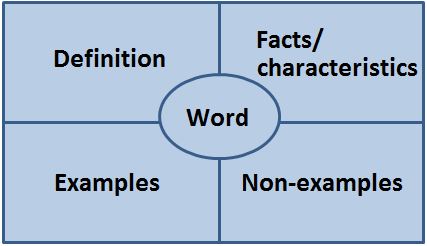
While reading Multiple Path's to Literacy, I was reminded of a technique I learned in a workshop once about teaching vocabulary -- especially math and science concepts.  Gipe called it the Frayer Model of vocabulary, which is summarized in the picture to the right. In this model, a definition, and examples are provided, as well as useful facts or characteristics. Also, several non-examples are listed, and I remember the presenter suggesting that students should list examples and non-examples -- and that you can provide equal praises for both.

For example, today we learned the vocabulary word "proportion" in algebra. The definition I provided was "an equation that compares two fractions"  Then I provided several examples such as 1/3 = 3/9 and x/5 = 24/40. One of the characteristics we mentioned was that true proportions can be cross-multiplied, which results in another true equation which doesn't contain fractions.  We also provided a non-example of 3/x=5 and also x/2+5 = 3/8.  

In physics, I have a similar model for teaching different quantities. I give a definition, a have a category called units, a category for examples, and a category for formulas containing that quantity. For example, "force" might have: 
   def: a push or pull on something
   units: Newtons, lbs, tons, ounces, (1 lb = 4.45 N) (16 ounces = 1 lb)
   examples: an apple weighs 1N.  Throwing a ball requires around 50 N.  
   formulas: Fnet = m*a,    Fgrav = m*g,  Ffric = mu*Fnormal ...

I like teaching vocabulary in a direct way -- and consistently.  I do that well in physics, but am not as organized in algebra. I'd like to consider giving each student a notebook to create a classroom dictionary -- but wonder if that's too childish for a high-school classroom? 

Tuesday, October 4, 2011

Revisions and Edits

In Multiple Paths to Literacy, Joan Gipe makes a distinction between revision and editing that I had never thought of before.  She describes revision as be concerned with content and editing being concerned with mechanics.  Revision is when you consider reordering the information, grouping it together or splitting things apart, adding material or taking away material, etc.  Editing is when you scour the paper with a fine-toothed comb looking for missing periods, misspellings, and other grammar mistakes.

I know that I am a very good editor usually. My brain is wired that way, to understand the rules of writing and to abide by them.  My weakness is in revising and considering what content should and should not be in a piece of writing.

What struck me most about the distinction was the emphasis that Gipe put on revision. She suggested students do several drafts where all that is done in between is revision. She even said that good writers are seldom concerned about correct language conventions until they are ready to edit their work. This surprised me, having such an editors mindset. I think first about grammar mistakes. It makes sense however -- why bother thinking about whether that sentence needs a comma or a semi-colon if you're not even sure if that sentence is going to be in the final draft at all?!  Who if you use who versus whom if you're still considering what characters to describe in your story and how much description to use?

This suggested to me the principle of the plank-in-the-eye image from the Bible. I am often concerned with the small specks in my writing, and the few pieces of writing my students turn in. What I need to focus more attention to is the outlining, the content, and the revision steps that my students and I go through when producing a paper.

I also need to implement a draft or two with the lab reports my students produce, so that they can look at what they have and what they need to add/change. Currently I only look at their lab reports after they are "finished" and I immediately grade that piece. Consequently, their writing is usually poor, and missing crucial elements. I do allow them to resubmit a second draft, but it might be more beneficial to all of us if we all did that purposefully, rather than some doing it haphazardly.

Wednesday, September 28, 2011

Three Reading Levels

In Multiple Paths to Literacy I read about three different reading levels that teachers consider when assigning reading materials to their students.  The first level is the independent reading level.  This is the level at which a student should be able to read everything with little or no difficulties.  This type of reading is fun, because it is fast, satisfying, and not frustration.  I think of it as "green light reading"

A second level is the instructional reading level, which students should be able to read most of, but occasionally need a teacher or someone else around to help with new words, or mispronunciations.  This level of reading usually produces the most learning and "growth" for the students because it pushes them just a little beyond their comfort zone.

The third level is called the frustration reading level -- what I consider "red light reading".  This level is too difficult for students, even with help and guidance, and Gipe calls this the "groan zone". This is when students start squirming, crying, misbehaving, or just stop enjoying reading.

Ideally, teachers would know what these levels are for each student, and push them to the growth zone as often as possible.

This concept reminded of weightlifting -- which believe it or not, I have done.  In weight lifting, while it might be fun to spend all your time with green weights, you will not grow if you don't push yourself to try harder weights.  Of course, if you are not aware of your limits, you can cause significant damage by attempting to lift weights too high for your muscles.  Ideally, you want to push yourself to spend time in the yellow zone, where you are able to do multiple repetitions, yet still struggling some what, so your muscles have to break down in order to rebuild.

Assigning problems in mathematics is similar -- If I assign students that are too simple, it ends up being a waste of the students time.  If I assign problems that are too difficult, then the students won't be able to gain anything from them, and may get turned off, frustrated, angry, or lose confidence.  My goal in assignments is to meet in the middle. I sometimes call them Goldilocks problems....

Observations and Standards Based Grading

Peter Johnston was quoted in Multiple Path's to Literacy describing the language we use about our own assessments as teachers, and the large-scale assessments the state requires:
We refer to our own observations as "subjective", "informal", and "anecdotal", where as we refer to tests as "objective" and "formal".  Our own language devalues the close knowledge we have and values distance. It would be more helpful if we referred to our own assessments as "direct documentation" and test-based assessments as "indirect" or "invasive."  These uses of language are far from trivial.  They show that we do not value our own assessment knowledge.  Our unfortunate cultural concern for control, distance, objectification, and quantification does not favor teachers, whose knowledge is often intuitive, usually nonnumerical, more inclined to the narrative, and gained through personal involvement.  Detailed knowledge comes from proximity and involvement, not distance.
I read this quote the day after I had a conversation with a parent of mine who disagreed with my grading scheme this year, because I am using much more observation of my students as the grade, instead of simply recording the students scores on assignments and tests. They were surprised and confused that I was taking a subject that is traditionally so objective, and making it subjective. At the time, my confidence was shaken and I almost decided to change and return to a more common method of simply recording assignments and tests scores, because after all, they are objective and numerical.

However, in the past two weeks, I have been able to make many observations of my students.  I feel quite confident that those observations are working better, and are being communicated better through my current standards based grading scheme, than they ever were before.  Now if a parent, student, or tutor asks if there's anything I can work on, I can point directly to skills that they have not yet mastered and confidently direct their studies.

While this quote was directed towards teachers of reading, writing, and literacy, which would be more 'nonnumerical' subjects for grading -- I think it applies equally well to algebra and physics.  I CAN tell, either by watching or listening to a student, what they understand and what they are still not getting, without just having students complete a quiz or test. However, a quiz or test is still one of the most efficient ways of me addressing a lot of different ideas and topics, and so I'm sure I will never be getting rid of them.

Link: explanation of my grading scheme: sites.google.com/site/roerclass/algebra

Monday, September 19, 2011

Why do I gots to teach literacy!? I'm a math teacher!


In her book Literacy Multiple Paths to Literacy, Joan Gipe describes literacy as multidimensional. I see literacy as having three unique axes, much like the x-, y-, and z-axes familiar to most math teachers. The literacy x-axis would be reading and writing. Both are communicating, but in different directions. Reading is the input of information in written or typed form. Writing is in the opposite direction, as a person chooses to communicate by paper, pencil, or typed form. The literacy y-axis would be speaking, and listening. Again, both are different directions of the same method of oral communication. Finally, the z-axis would be viewing, and visually representing. This would be through pictures, demonstrations, gestures, graphs, and drawings.

My classroom is an algebra 1 and physics classroom. Before reading Gipe’s definition of literacy, I was certain that my classroom had very little literary content involved. We don’t do reading, I thought. However, Gipe described literacy as the ability to communicate, and not simply reading. Instantly I realized that there is a lot of literacy teaching going on in my classroom. Most of this is as the students in my algebra classrooms are learning to communicate using abstract ideas, and writing in a new language called algebra. I became aware that though I never teach finding subjects and verbs of sentences, I do teach them to break an expression down into individual terms. While I never teach my students how to sound out a word by emphasizing phonics, I do teach them to identify parts of terms, such as the sign, the coefficient, and the variable part.

In fact, I see all three dimensions of Gibe’s definition of literacy appearing in my classroom. In a very literal sense, students are reading the textbook, following examples. In a more general sense, students need to learn to read the language of algebra, by interpreting expressions, equations, formulas, and inequalities. Students need to write their answers using a new language, as well as communicate their thinking steps using the agreed upon conventional algebraic notation.

Students also operate among the speaking and listening dimension in class. I deliver much of the new information through lecture format, where students must listen and interpret. We often correct our assignments in class, sharing answers aloud where ‘pronunciation’ must often be addressed as students will say “x-two” instead of “x-squared” or “x to the second power.”

Many times in algebra, students are also learning new ways of illustrating relationships, by way of graphs. Most commonly this is via the Cartesian xy-plane and through graphs of lines and functions. We also use xy-tables to show relationships, and at times interpret other statistical graphs such as box-and-whisker-plots, pie charts, and scatterplots with line-of-best-fits. Students learn to make such graphs both on paper and on a computer, as well as how to interpret, and make extrapolation and interpolation predictions from such graphs.

In physics, we are doing much of the same, although at a deeper level. We spend much of our initial efforts focusing on the information that the units of an number can tell us, much like the use of various suffixes determines the type of word used. Our vocabulary has increased, and continues to grow as new quantities are precisely defined via formula. I teach specific writing skills as my students write lab reports, and I often need to correct their use of vocabulary words, such as the common effect/affect mistakes. Finally, graphs continue to be used, but primarily the line-of-best-fits becomes the tool of choice to show if and how two quantities are related.

My first reaction to taking a literacy course was that it was completely irrelevant to me as a high school math and science teacher. I initially had no motivation for the course, seeing it as just a hoop to jump through to earn my masters, and stay certified to teach. While I admittedly am not excited to take the course, I am happy to find that learning about teaching literacy will be much more applicable than I ever imagined.
Related Posts Plugin for WordPress, Blogger...