Pages

Showing posts with label constellation. Show all posts

Monday, February 25, 2013

The Constellation Leo

This post is the one of a series on constellations and posted throughout the year as each constellation comes into prominence.
Leo is one of my favorite constellations. It was one of the first after I fell in love with astronomy in 2008. It was the first one that I had never noticed before, but set out to find and add to my repertoire.

Leo is a lion, and one of the constellations that I feel actually looks like its supposed to:
Leo the Lion
Image by Backyard Stargazing
It reminds me of the sphinx:

What helped me to identify Leo was to find the sickle -- the curve of six or seven stars which I call the "backwards question mark".  The dot of this question mark is the brighest star in Leo, called Regulus, or Reggie for short. At #15, he is one of the brightest stars in the northern hemisphere. He lies almost exactly on the eclipitic.

Lying along the ecliptic, Leo is therefore a zodiacal constellation. This means the sun, moon, and the planets periodically pass through Leo. When I was first learning about it, in 2008, Saturn was moving around under Leo, though now it has moved on and is located in the relatively blank section of sky in Virgo and Lyra.

The sun passes through Leo from mid-August to mid-September, which makes Leo a nice constellation to look for in late winter and spring. I find it by locating the Big Dipper, and pretending it is dripping things. If it drips things down thru the cup, those drops would fall on Leo's head:
The Big Dripper and Leo

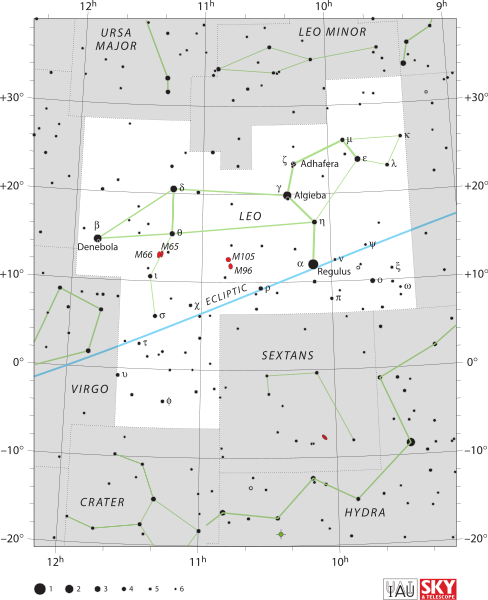
Below is a more specific map of Leo.  With a telescope, Leo houses a few good Messier objects worth looking for, but none are good sights for binoculars.
Leo
Image from Wikipedia

Friday, January 4, 2013

The Constellation Canis Major and Minor

This post is the one of a series on constellations and posted throughout the year as each constellation comes into prominence.
I came across this article on New Years Eve which inspired me to write a post about the star Sirius, and its constellation.

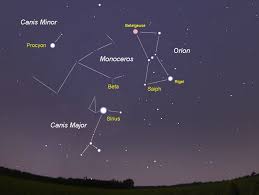
Canis Major and Canis Minor are two constellations near the famous Orion, and are worth knowing because they house two of the brightest stars in our sky.  Canis means Dog, and so these constellations are the Big Dog and the Little Dog. I see a bad stick figure and a pair of dots myself, but I suppose with a little imagination, it wouldn't be too much of a stretch to see them as Orion's hunting dog's, following him into the woods perhaps.

These constellations are only just starting to come out in the evening hours during winter -- so unless you're out relatively late, you might not see them. The inspiring article described Canis Major as reaching it's highest point in the sky at mid-night on New Years Eve, which means if you went out at a more "normal" star-watching time at least for parents such as myself -- say 7 or 8 pm -- it won't be up yet.
Fall Mornings
Winter Nights
Spring Evenings
The dog constellations serve to tell me about our progress through the school year.  At the beginning of the year, and through first semester, I tend to see them on my drive in in the mornings. As the year progresses through winter I won't see them as often, as they'll be out in the middle of the night. As the year reaches the end, these dogs are out and observable during family-friendly observing times of just before bedtime during the spring months -- March April or May.

Canis Major is a southern hemisphere constellation -- one that is approximately 20° below the celestial equator. At my latitude, that means it is not out for too long each day -- only about 8-9 hours a day. Canis Minor on the other hand is just barely a northern hemisphere constellation - approximately 5° above the celestial equator. That means we can see Canis Minor longer each day -- about 12-13 hours a day.

One of the reasons for observing the Dog's is because of the bright stars they contain. Sirius is the brightest star seen anywhere from earth, short of the sun. It's the bright one in Canis Major -- or the head of the stick figure in my  minds workings. Procyon in Canis Minor is another bright star - 6th brightest in the sky for Northern observers. I often confuse the pair of stars in Canis Minor with the pair in Gemini, as they are about the same width in the sky. You should be able to tell the difference two ways. First, in Gemini they are both bright stars, where as Procyon far outshines its partner in Canis Minor.  Second, Gemini is to the right of Orion and Canis Minor is above and to the left.

Many people describe these two bright stars, and the red giant Betelguese as forming a great Winter Triangle in the sky. While I could draw this triangle in the sky -- it doesn't really pop out at me.

Winter Triangle

Another feature of Canis Major, is that it contains one of the biggest known stars -- what Louie Giglio described as "The Big Dog Star" in one of my favorite sermons of all time: How Great is Our God. At this link you may begin watching the portion where he describes The Big Dog Star. In it he compares a series of increasingly large stars with the earth as the size of a golf ball. On that scale, VY Canis Majoris would be the size of Mount Everest. Somewhere in Canis Major is a star too faint for you to see that is larger than the orbit of Jupiter around our sun. Put another way, if this star was where our sun was, we would be IN it -- not looking at it, and so would Mars and so would Jupiter. 

Sunday, December 30, 2012

The Constellation Gemini

This post is the one of a series on constellations and posted throughout the year as each constellation comes into prominence.

Gemini is an important constellation to learn for a number of reasons. Known as the twins, it is home to two of the brightest stars in the sky -- Pollux and Castor. Pollux on the left is the 12th and Castor the 16th brightest stars in the Northern hemisphere. These stars are the heads of two twin brothers standing side by side. On a good night, you can see lines of stars outlining the bodies, as shown below:
Gemini
Image from Wikipedia
Gemini is one of the 12 zodiacal constellations, which means it lies along what's called the ecliptic. The ecliptic is a circle of constellations surrounding us which lies along the same plane as the planets and the solar system as a whole. Therefore, any planets you see are always somewhere along this plane. Gemini is therefore useful to know as planets are often located nearby.  For instance, the bright planet Jupiter will be approaching Gemini early 2013 and spend late 2013 and most of 2014 within the region.

Being along the ecliptic means that the moon will pass through the constellation once a month.

Being along the ecliptic also means that the sun will pass through the constellation (rendering it invisible of the brightness of the sun) once a year. The sun passes through Gemini from May 21 to June 20 each year. During the winter months, the sun is in the opposite side of the sky which makes Gemini an easy constellation to see.

Below is a map of the surrounding constellations for the evening hours in December.
2012 December skies ~ 7pm
2013 January skies ~ 6pm
Image by Skymaps
As you can see from this image, Gemini is pretty easy to spot -- being above and to the left of the familiar constellation Orion. Finding the bright head stars should be easy to do, but next time you have a clear night, see if you can identify some of the other stars making up the body. I have often seen them as forming the Greek letter Ω (Omega).

Of course, a description of Gemini would be incomplete without mentioning the Geminids, a meteor shower that is one of the best in the year. During the nights around December 13 and 14 each year, many bright meteors (sometimes around 100 per hour!) can be visible. They emanate from Gemini - which means they will go outwards away from Gemini. They don't always begin in that constellation, but their paths will tend to point away from Gemini more often than not. Most meteor showers are best observed in the wee morning hours.

A good binoculars object, M35 is a nice cluster of stars that will be my goal to find in the next month. It has the width of the moon, and contains well over 200 stars, but most are invisible to the naked eye. Castor is supposedly juggling it on his foot like a soccer ball.
Related Posts Plugin for WordPress, Blogger...